

Adopt Legal AI
Without Adopting Risk.
A free 9-page field guide with 16 questions every attorney should ask before connecting an AI tool to a client matter — mapped to the ABA Model Rules and Formal Opinion 512.
Get the Free Guide ↓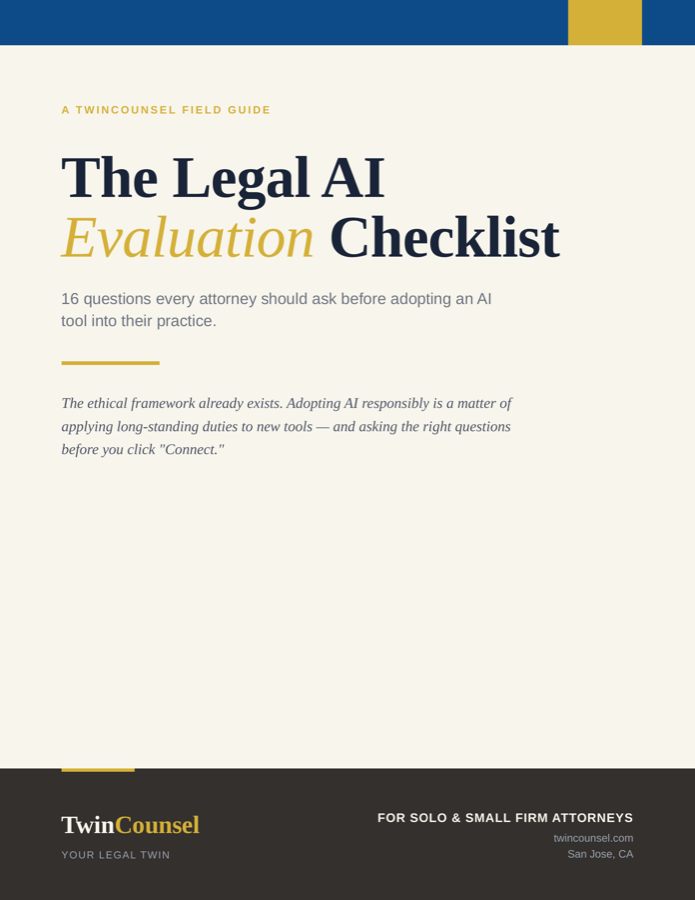
Why This Checklist · Why Now
The ethical framework already exists.
“AI doesn't change your duties. It changes the surface area where they apply.”
Competence. Confidentiality. Supervision. Independent judgment. The rules that govern our profession have governed it for decades — and they apply to every new tool a lawyer adopts, AI or otherwise.
The question isn't whether AI requires a new ethics framework. It's whether this particular tool lets you keep meeting the duties you already have. That's a procurement question, a vendor-diligence question, and increasingly an evidentiary question.
With ABA Formal Opinion 512 issued in July 2024, that diligence now has a specific shape. This checklist gives you the shape — sixteen concrete questions to ask before you click “Connect” — so you can adopt legal AI with the same care you bring to every other professional decision.
Mapped to the Authority Already on the Books
What's Inside
Four sections. Sixteen questions.
One go / no-go decision.
Every item is tied to the ABA rule it implicates, with a “why it matters” note and Yes / Partial / No checkboxes so you can fill it out live on a vendor call.
Foundation & Provenance
Who built this, what it's actually doing under the hood, and whether you can explain it to a client, opposing counsel, or a judge.
Data, Security & Confidentiality
The largest single category — because confidentiality is the single largest area of exposure when you introduce AI to a practice.
Ethics & Human Oversight
AI should enhance judgment, never replace it. Is the tool structurally aligned with that — or does it just claim to be?
Workflow & Long-Term Fit
A tool that passes every ethics test but doesn't fit how you actually practice will quietly fail. This is where you stress-test that.
The Bottom Line
AI doesn't change your duties. It changes the tools you use to meet them.
— The TwinCounsel Field Guide
Who Built This
Your Legal Twin knows your case.
TwinCounsel is an AI colleague built specifically for solo and small-firm attorneys. It connects to your email and handles its share of your practice — privilege-safe by design, every fact cited, every output auditable.
The checklist you're about to download is the same evaluation framework we held ourselves to when we built it. If a vendor can't answer most of these 16 questions clearly, in writing — that's itself an answer.
See how TwinCounsel works →You're the editor, not the author. The product architecture should make that posture the default — not a discipline you have to remember.
From the Field Guide · Item 10, Human Oversight
Get the checklist. Use it on your next vendor call.
Walk in with sixteen questions, a scoring rubric, and a clear go / no-go framework. Walk out with a decision — not a vendor pitch.